Last updated October 21, 2026
AI phone agent that answers and qualifies inbound calls
- Voice agent
- Inbound calls
- Lead qualification
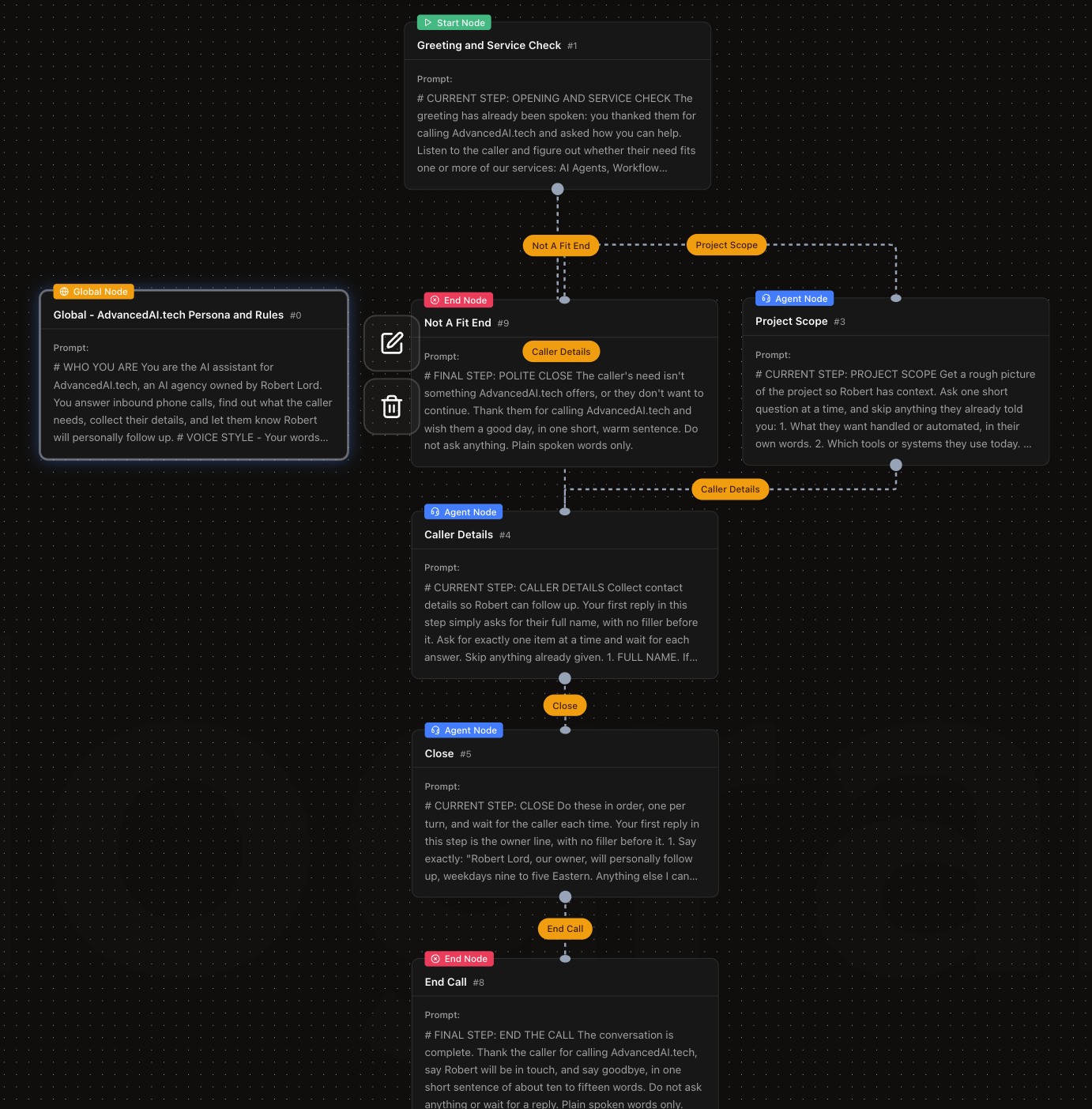 Open full-size workflow image
Call flow
A global persona node sets the voice style and rules for every step: short, plain spoken words, one question at a time, never pushy.
Step 1: Greeting and service check
Thanks them for calling, asks how it can help, and checks whether the need fits our services.
Step 2: Not a fit
Politely closes in one short, warm sentence.
Step 3: Project scope
Asks one short question at a time: what they want handled or automated, and which tools they use today.
Step 4: Caller details
Collects one item at a time, starting with full name, then contact details.
Step 5: Close
Says Robert Lord will personally follow up weekdays 9 to 5 Eastern, and asks if there is anything else.
Step 6: End call
Thanks them, says Robert will be in touch, and says goodbye in one short sentence.
This is the inbound phone line for AdvancedAI.tech. The agent answers the call, figures out what the caller needs, collects their details, and tells them Robert will personally follow up.
It is a voice agent with a global persona and a short chain of steps. Each step asks one thing, skips anything the caller already said, and either continues or ends the call.
How does the AI phone agent handle a call?#
- Greeting and service check. The agent thanks them for calling, asks how it can help, and checks whether the need fits our services — AI agents, workflow automation, and related work.
- Not a fit. If the request is not something we offer, the agent politely closes in one short, warm sentence. No extra questions.
- Project scope. One short question at a time, skipping anything already said: what they want handled or automated, in their own words, and which tools or systems they use today.
- Caller details. One item at a time, starting with full name, then contact details so Robert can follow up.
- Close. The agent says Robert Lord, our owner, will personally follow up weekdays 9 to 5 Eastern, then asks if there is anything else.
- End call. It thanks them, says Robert will be in touch, and says goodbye in one short sentence.
What rules apply on every turn?#
A global persona node sets the voice style and rules for every step. The agent speaks in short, plain spoken words. It asks one question at a time. It is never pushy. It does not invent details, and it does not try to close a sale on the call.
Why is the call designed this way?#
A few choices keep the conversation short and useful:
- One question per turn. The caller is not asked to answer a list. Each reply unlocks the next question.
- Skip what is already answered. If someone already gave their name or described the project, the agent does not ask again.
- Early exit for non-fit callers. If the request is outside what we do, the call ends quickly so nobody's time is wasted.
- Hand-off to a human. The agent qualifies and collects details. The actual sales conversation is a follow-up with Robert, not a pitch on the call.
Results#
Results: coming soon.
Frequently asked questions#
Can it work with my existing phone number?#
We set it up around your current setup. The exact wiring depends on the phone system you already use.
What happens after the call?#
The agent collects the caller's details and tells them Robert will personally follow up. Robert then reaches out on a weekday, 9 to 5 Eastern.
Can it book appointments?#
This version qualifies the caller and sets up a follow-up. It can be extended to book appointments if that is part of the process you want handled.
Does a person still talk to the caller?#
Yes. The agent answers and qualifies. Robert handles the conversation that comes next.